When Ancient Wisdom Meets Modern Physics

Quantum entanglement describes a state in which particles that have once interacted remain connected beyond space and time. Even when separated, a change in one is reflected in the other, suggesting that relationship, rather than distance, defines their existence.
As I searched deeper into understanding Khwan, I found myself drawn unexpectedly to Quantum Physics specifically to the concept of Quantum Entanglement. On the surface, these seems like entirely different domains: one a traditional belief system rooted in ritual practice, the other cutting-edge science dealing with subatomic particles. Yet I discovered a surprising resonance.
Quantum Entanglement describes a phenomenon where particles that have interacted continue to affect each other instantaneously, regardless of the distance separating them. Once two particles become entangled, measuring the state of one immediately influences the state of other, even if they’re light-years apart. Einstein famously called this “Spooky Action at a Distance” because it seems to violate our common-sense understanding of how the universe works.
What fascinated me wasn’t the physics itself—I’m not trying to use quantum mechanics to “prove” anything about Khwan or validate traditional knowledge through Western science. Rather, I was struck by the parallel questions both systems ask:
- How are things connected?
- What does it mean for something to be related to something else?
- Can entities that seem separate actually be part of a larger, interconnected whole?
In quantum physics, the answer is that at the most fundamental level, particles that have once interacted remain connected in ways that transcend physical space. In Khwan philosophy, human beings are never truly separate from each other, from their ancestors, from the land, or from the cosmos. Both systems challenge the notion of discrete, independent entities existing in isolation.
Fritjof Capra wrote in “The Tao of Physics” that ancient wisdom and modern science often explore the same truths using different languages and methods. I don’t think this means they’re saying identical things, but rather that they’re both grappling with fundamental questions about connection, relationship, and the nature of existence.
The more I studied, the more I noticed structural similarities. Khwan are described as particles or units of life force that can scatter and must be called back. Quantum mechanics speaks of particles existing in superposition, their states uncertain until observed, their relationships transcending space and time. Both systems describe reality not as solid and fixed but as dynamic, interconnected, and dependent on relationship.
Of course, Khwan relates to meaning, memory, and emotional coherence, while quantum entanglement is a mathematical description of physical phenomena. One emerges from ritual and lived experience; the other from laboratory experiments and equations. They operate in different domains and shouldn’t be conflated.
Yet both offer alternatives to the Newtonian worldview that dominated Western thought for centuries—the idea that the universe consists of separate objects acting on each other through direct, local contact. Both suggest instead that reality is fundamentally relational, that separation is more apparent than real, that what appears distant may in fact be intimately connected.
This parallel isn’t about validating one system through the other. Rather, it’s about recognizing that across cultures and epistemologies, humans have repeatedly arrived at similar insights: we are not alone, we are not separate, and the invisible connections between things may be as real and consequential as the visible ones.
Particles of Meaning

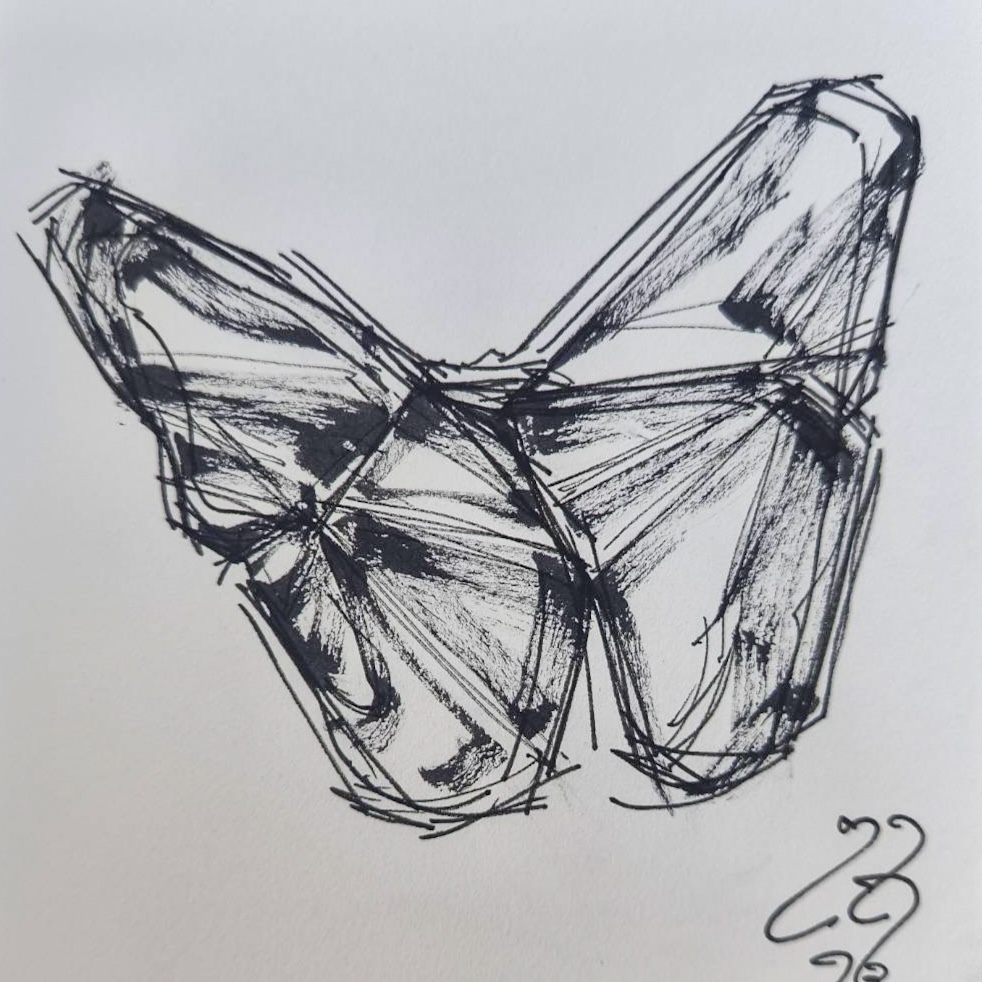
My concept sketch exploring Khwan in Tai culture
I began to think of Khwan as “particles of meaning”, the smallest units that compose our sense of self, our emotional stability, our ability to be present in our lives. Just as particles in physics can be described as both particles and waves, existing in multiple states simultaneously until observed, Khwan exists in a space between the physical and the metaphysical, between body and spirit, between individual and collective.
When I lost my Khwan, when panic disorder fragmented my sense of self, it wasn’t that some literal entity fled my body. Rather, the coherence that held together my physical sensations, emotional responses, memories, and sense of identity came undone. The relationships between these elements — the “entanglement” that made me who I was — became disrupted.
Calling back Khwan, then, isn’t about retrieving something that physically left. It’s about restoring coherence, rebuilding connections, reweaving the network of relationships (both internal and external) that constitute a self. It’s recognizing that we are not solid objects but ongoing processes, patterns of relationship that must be continuously maintained and renewed.
This exploration has left me with questions rather than answers, but I’ve come to value these questions:
- What are the smallest components that make us who we are? Not just physically cells, molecules, atoms—but experientially, emotionally, spiritually? What are our “particles of meaning”?
- How are these components connected? What maintains the coherence of our sense of self, and what causes it to fragment?Can connection persist across distance, across time, between people, between past and present, between the living and the dead?
- When something within us falls away through trauma, loss, illness, or fear—how do we call it back? And when we do, does it return unchanged, or do we reconstruct ourselves differently, incorporating absence and presence, fragmentation and wholeness, into a new configuration?
These questions don’t have definitive answers, but the process of asking them is itself a form of healing. It’s a way of acknowledging that fragmentation happens, that loss is real, and that the work of restoration is both possible and necessary.
Coming Back to Ourselves

My journey through panic disorder, through the Su Khwan ceremony, through the study of traditional knowledge and modern physics, hasn’t led to a neat conclusion. I haven’t “solved” the problem of selfhood or discovered the ultimate nature of reality. But I’ve found something more valuable: a way of thinking about healing that doesn’t demand we return to an original state but instead invites us to reconstruct ourselves with intention and care.
The Khwan that returns may not be identical to the Khwan that left. We may not be exactly who we were before we broke. But perhaps that’s not the point. Perhaps healing isn’t about restoration but about integration—taking what has been scattered and finding a new arrangement, a new coherence that includes both what was lost and what was found in the losing.
In the end, whether we speak of Khwan or Quantum Entanglement, of ritual or physics, we’re talking about the same fundamental human need is that to understand how we’re connected, to each other and to the world, and to find ways of repairing those connections when they’re broken. We’re asking how to come back to ourselves when we’ve drifted away, and how to help others do the same.
This is the work of being human—this constant practice of falling apart and coming back together, of losing ourselves and finding ourselves again, of recognizing that we were never meant to be solid and unchanging but rather fluid, relational, and always in the process of becoming.

 WATHIT SEMBUT
Leave a comment