

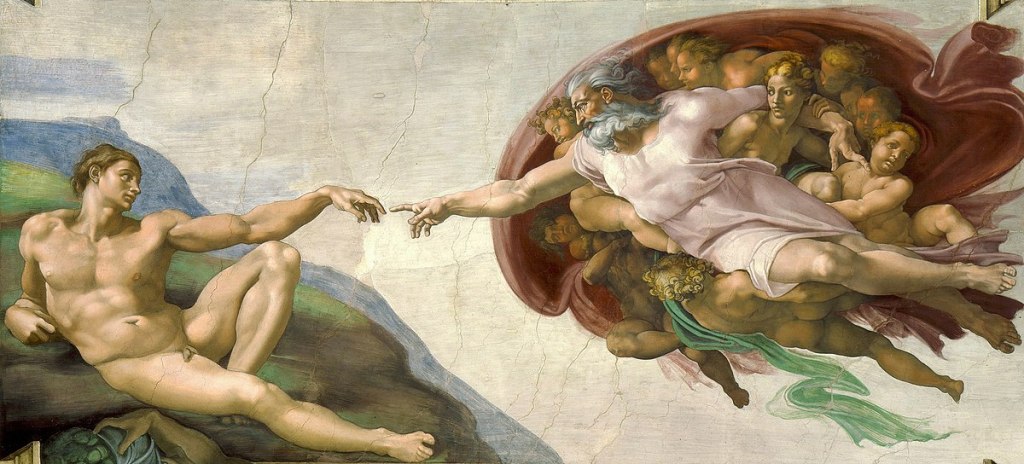
The Creation of Adam by Michelangelo
Scientific Discoveries, Existentialism, and our Common Origin
Looking back through the timeline of modern humans evolution, when Richard Leaky and his research team from the National Museum of Kenya discovered the Omo I and Omo II human skull fossils between 1967 and 1974, dated at over 233,000 years old, amidst the quiet Ethiopian desert at the Omo Kibish site along the Omo River, they unearthed more than just archaeological evidence. They opened a new window into understanding our own humanity.
- Who are we?
- Where did we originate?
- What is the purpose of our existence?
From a perspective of faith, these scientific traces might be viewed as as messages from a creator sent to us, not in written text, but manifest in the sequence of bases in DNA helices and in rock layers accumulated over hundreds of thousands of years.
Jean – Paul Sartre’s philosophy proposed that “existence precedes essence”, as humans are born first, then define themselves, creating meaning in life through their actions.
But when confronted with scientific evidence indicating the long evolutionary journey of humanity, we might need to reconsider this question: if we descend from common ancestors in Africa, or if we all share a “Mitochondrial Eve” and “Y – Chromosomal Adam” from the same ancestral group, perhaps there is some essential nature that all humans share even before we have the opportunity to define ourselves.
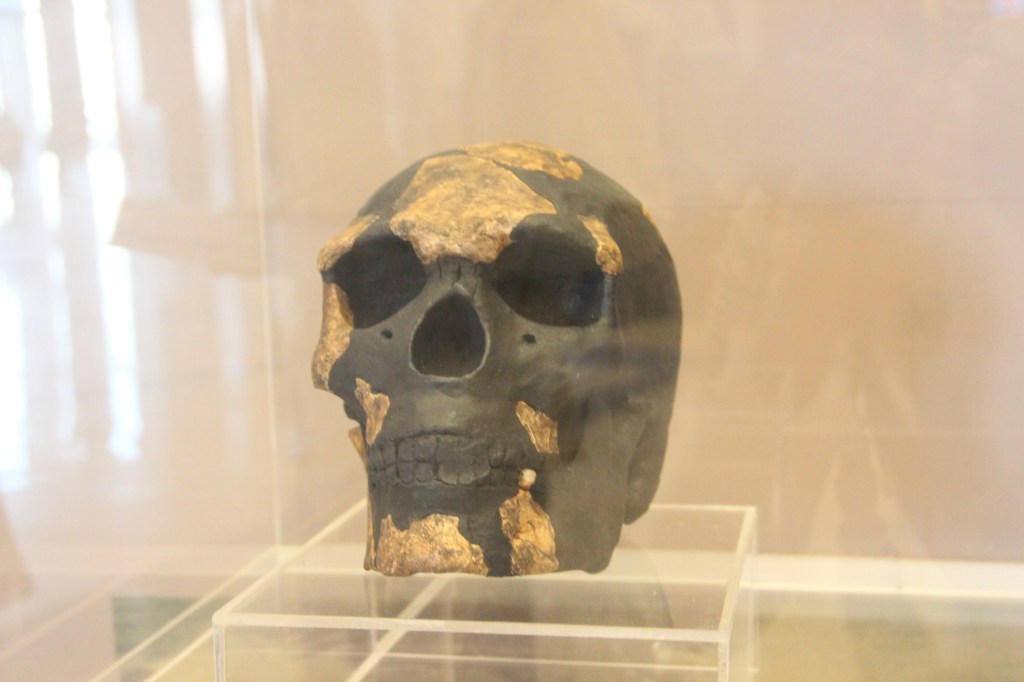
Reproduction of the Omo-Kibish skull, Musée des Civilisations Noires de Dakar (Sénégal). Credit: GuillaumeG
When Rebecca Cann, Mark Stoneking, and Allan Wilson published their research on “Mitochondrial DNA and human evolution” in 1987, they may not have realized they were sparking a new awakening for humanity – the realization that we all descend from common ancestors.
Scientific evidence suggesting that all modern humans (Homo Sapiens) originated in Africa approximately 200,000 – 300,000 years ago is mot merely a biological fact but reveals a profound philosophical truth:
”All humanity is one single family.”
The Dasein of Shared Human Experience and Genetic Heritage

Martin Heidegger, 1968 in Todtnauberg. Source : bpk / Digne Meller Marcovicz
While animals generally rely on instinct for survival, humans posses a consciousness that questions reality. We created religion, philosophy, and science in attempts to answer seemingly unanswerable questions such as:
- Why we are here?
- What is the purpose of life?
- Where do we go when we die?
German Philosopher Martin Heidegger spoke of “Dasein” or “ being – there” as the unique human condition of being able to question the meaning of one’s own existence. The discovery of anthropological evidence about early human evolution thus presents a significant opportunity to ask new questions about the meaning of our collective existence on this planet.
Discovering that humans share common roots is not merely about the past but reveals the direction of our future, the return to unity at a higher level through humanity’s collective awakening. When we understand that our DNA originated from the same “Mitochondrial Eve” and “Y – chromosomal Adam”, we cannot deny that differences in races, skin color, and culture are merely superficial phenomena resulting from human adaptation to different environments over just a few tens of thousands of years.
The renowned analytical psychologist Carl Jung proposed the concept of the “Collective Unconscious”, a deep part of the psyche connecting all humans. He believed that deep in our minds. All humans share common symbols and thought patterns (Archetypes) inherited from ancestors.
This concept aligns remarkably with genetic discoveries showing that all humans share common ancestors. Awakening, from Jung’s perspective, means accessing and understanding this collective unconscious to discover that we are all part of something greater than ourselves. Perhaps, the desire to discover the truth about our origins is part of a deeper consciousness, or perhaps humanity’s intellectual capacity to study its own traces is a part of a greater mission entrusted to us by universe.
”We are not merely living beings evolved for survival, but also those chosen to search for the meaning of existence.”
Bridging Science and Spirituality Through The Next Awakening

“Paṭiccasamuppāda” by Songdej Thipthong
For centuries, science and religion have been viewed as conflicting poles, but discoveries about the origins of modern humans may bridge these two paths. Many religions have myth about humans originating from common ancestors, which align with some genetic evidence we’ve discovered today.
Perhaps certain truths are told through different languages. Religious studies often use symbols and myths to convey meaning, while anthropologists and scientists use numerical evidence and fossils, but their essence may be telling the same story.
Genetics is not merely code determining hereditary characteristics like shape, hair color, eye color, and skin color; it testifies to the interconnection of modern humans. This evidence tells us that regardless of our external differences, we are all siblings. Many religions have long spoken of this concept, whether through “Adam and Eve” in Judaism, Christianity, and Islam, or the concept of “Atman” in Hinduism emphasizing the unity of all life, while Buddhist philosophy discusses “Paṭiccasamuppāda” (Dependent Origination), the principle of co-arising or interdependence stating nothing exists in isolation. This principle aligns remarkably with scientific discoveries about the genetic web connecting all humanity.
Genetics evidence showing common human ancestors may remind us that what connects us is greater than what divides us. Differences in culture, ethnicity, and language are merely thin shadows over roots deeply planted in the same soil. Following the thread of history, we see humans often driven by curiosity, hope, and fear. Some might compare humanity’s journey to a universe becoming aware of its own existence.
From a religious perspective, one might say that God, the Creator, or the creative force of the universe communicates with us constantly through evolutionary traces, fossils, DNA, natural phenomena, and our own consciousness.
The important question is: “Are we listening?”
If human existence is a process of awakening, perhaps we stand on the threshold of the next level of consciousness, a level where we understand not only ourselves but also the universe and our role within it.
The discovery of humanity’s common origin should not be merely historical information but inspiration to create a better world, one filled with understanding, compassion, and awareness of our interconnectedness.
One might say that stories from the past are light guiding us forward with mindfulness. Perhaps true awakening lies not in looking back to find our beginning, but in looking forward to discover how we can journey together toward a better future.
And when that day comes, perhaps we will discover the true answer to our own existence.
Sources:


 WATHIT SEMBUT
Leave a comment